 KEYFACT Energy
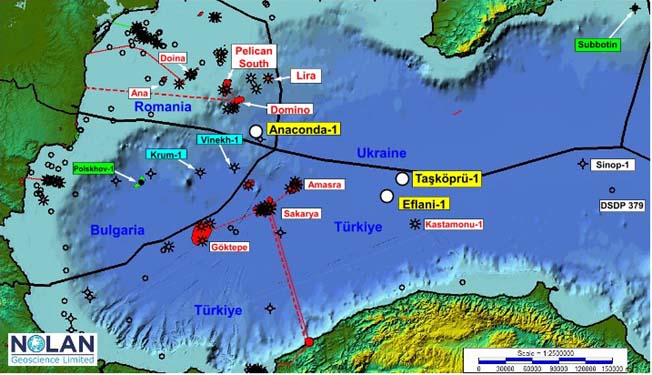
Türkiye Petrolleri A.O. (TPAO) mobilised the Fatih drillship from the Black Sea port of Filyos to the Taşköprü-1 exploration well. Taşköprü-1 is in 2164m water depth, 26km northeast of the recently completed Eflani-1 well and 10km southwest of the maritime border with Ukraine.
Eflani-1 was completed in June after 59 days of operations. TPAO have provided no information on the results of the well. At the end of May, energy minister Alparslan Bayraktar said that ‘ongoing work at Eflani-1 is promising’.
Both wells are believed to have been drilled on new TPAO 3D seismic. They are also close to the Kastamonu-1 exploration well, drilled in 2011 on 2D seismic by ExxonMobil and TPAO, that encountered a series of gas bearing Plio-Miocene sands with low gas saturations.
Taşköprü-1 and Eflani-1 are located at the distal end of the palaeo Danube where the reservoirs are likely to be thinner and poorer quality than the more proximally located fields and discoveries to the west. Interpretation of 2D seismic data indicates Taşköprü-1 and Eflani-1 are targeting broad low-relief structures. Key uncertainties are reservoir thickness, reservoir quality, and gas saturation (residual versus full).
Meanwhile in Romania operations to install the Neptun Deep Jacket are underway. Upon completion of the Neptun Deep development drilling, OMV Petrom will mobilise the Transocean Barents semi to the Neptun Deep extension license to test the Anaconda prospect. According to the March 2025 pre-drill EIA, Anaconda-1 is in 1547m water depth, and 5km northwest of the Flamingo-1 well drilled by Exxon in 2015. The total planned well cost for Anaconda-1 is up to EUR 90M, according to OMV Petrom.
Anaconda-1 will be drilled to a TD of 3780m MD and will evaluate two target reservoir intervals which will be tested if proven to be gas bearing.

Ciaran Nolan
Director, Nolan Geoscience Limited
KeyFacts Energy: TPAO Turkey country profile
