KEYFACT Energy
Oil & Gas
Thailand’s oil and gas industry is a mature upstream sector centered almost entirely on offshore production in the Gulf of Thailand, supported by a smaller onshore gas presence in the northeast and a well-developed midstream and downstream network. The country is a net importer of crude oil but has historically achieved a relatively high level of domestic natural gas production, which plays a critical role in its power generation, industrial energy supply, and petrochemical sector. The upstream landscape is characterized by a limited number of large operators, long-life gas fields, and a regulatory framework that has evolved from concession-based systems to production sharing contracts in newer areas.
The most important feature of Thailand’s upstream sector is the dominance of offshore gas production in the Gulf of Thailand. The basin contains multiple stacked reservoirs of gas and condensate, developed over several decades since commercial production began in the late 1960s and 1970s. These resources are typically found in shallow to mid-water depths and are tied into extensive pipeline infrastructure that feeds processing facilities and onshore distribution networks. Gas is transported primarily to support electricity generation, which in Thailand is heavily gas-dependent, making upstream reliability a key element of national energy security.
The largest upstream player is PTT Exploration and Production, the exploration and production arm of Thailand’s national energy group. PTTEP operates a wide portfolio of offshore fields and has grown into a regional upstream company with assets beyond Thailand. In the domestic context, it is the principal operator of gas fields in the Gulf of Thailand and plays a central role in maintaining supply stability. Its operations include mature gas field redevelopment, infill drilling, compression projects, and enhanced recovery initiatives designed to offset natural decline in aging reservoirs.
Another historically critical operator is Chevron Thailand Exploration and Production, which has been one of the most significant contributors to Thailand’s gas supply for decades. Chevron developed and operated major offshore gas fields in the Gulf of Thailand, particularly in the Erawan and nearby concession areas, which have been foundational to Thailand’s domestic gas system. Over time, Chevron’s role has transitioned through concession expiry and renewal processes, with operatorship and production rights being restructured and partially transferred to new operators under Thailand’s regulatory regime. Despite this transition, Chevron’s legacy development remains central to the country’s production infrastructure.
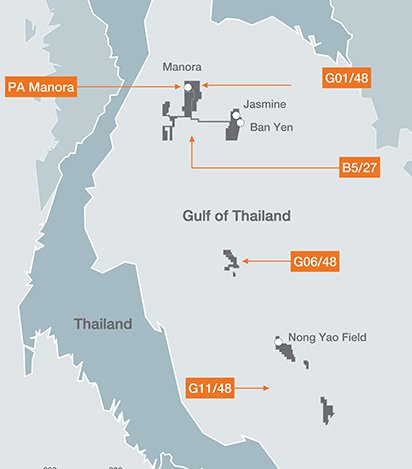
In recent years, independent operators have gained importance in Thailand’s oil segment, particularly in mature shallow-water fields. Valeura Energy has become the leading independent oil producer following its acquisition of offshore Gulf of Thailand assets previously associated with Mubadala Energy. Its portfolio includes fields such as Wassana, Nong Yao, and Manora, which are relatively mature but still productive through redevelopment drilling, workovers, and optimization programs. Unlike the gas-dominated portfolios of PTTEP and Chevron, Valeura’s focus is primarily oil production, making it somewhat distinct within the Thai upstream landscape.
Foreign participation in Thailand is typically structured through joint ventures rather than full operatorship. Companies such as Mitsui Oil Exploration Co., Ltd. participate as minority stakeholders in gas and oil developments, particularly in long-established offshore fields where infrastructure and production systems are already in place. These partners contribute capital and technical expertise but generally do not operate fields directly. This structure reflects Thailand’s preference for maintaining strong domestic control over upstream assets while still attracting international investment and expertise.
Historically, other international companies have also played roles in Thailand’s upstream sector. Companies such as Mubadala Energy and earlier participants like KrisEnergy and TAP Oil were involved in exploration and production activities, but their presence has diminished over time due to portfolio restructuring, financial challenges, or strategic exits. As a result, the current upstream landscape is more consolidated than in previous decades, with fewer operators managing a mature asset base.
The regulatory framework governing Thailand’s upstream sector is overseen by the Department of Mineral Fuels under the Ministry of Energy. The country has used a combination of concession systems and production sharing contracts, depending on the timing and nature of licensing rounds. Production sharing contracts have become more prominent in recent years as Thailand seeks to attract new investment while maintaining state control over resource ownership. The Joint Development Area (JDA) between Thailand and Malaysia is a notable exception, where cross-border gas and condensate resources are jointly managed and developed under a bilateral agreement.
Midstream infrastructure is a critical enabler of upstream operations in Thailand. Offshore gas is transported via pipelines to onshore processing plants and then distributed through a national grid system. The state-linked energy group plays a central role in gas purchasing, transmission, and allocation to power plants and industrial users. This integrated structure means upstream production decisions are closely linked to domestic electricity demand and long-term energy planning.
Overall, Thailand’s oil and gas sector is best described as a mature, gas-weighted offshore province with a small but stable oil production segment. It is dominated by a few key operators, supported by international joint venture partners, and underpinned by extensive infrastructure that connects offshore production directly to national energy consumption. The sector’s long-term trajectory is shaped less by exploration expansion and more by optimization of existing fields, gradual decline management, and selective redevelopment opportunities to sustain domestic supply security.
Upstream energy company operations in Thailand
APICO
APICO has been active in the country for several decades, concentrating on exploration, development, and production of crude oil and associated natural gas.
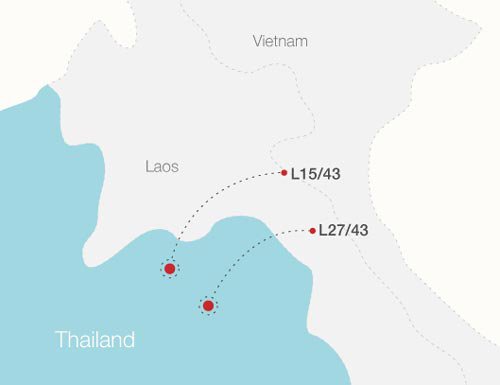
APICO’s core assets are located in the Phitsanulok Basin in central Thailand. The company holds interests in the Sinphuhorm, L33/43, and L44/43 concessions, where it operates multiple onshore oil fields. These fields produce light to medium crude oil, which is transported by truck to local refineries within Thailand. The operations are conventional onshore developments using vertical and directional wells, supported by surface production facilities that separate oil, gas, and water before transport or reinjection.
In addition to oil production, APICO produces associated natural gas. A significant portion of this gas has historically been sold to Thailand’s state energy company, PTT Public Company Limited, for use in domestic power generation and industrial applications. This integration into Thailand’s domestic energy market makes APICO an important independent contributor to local supply rather than an export-focused producer.
CapAllianz
CapAllianz manages a portfolio of oil and gas investments, with its core investment located in Thailand.
Loyz Thailand, a wholly-owned subsidiary of the Group, holds a 20% participating interest in three producing concessions — SW1, L44/43, and L33/43, located in the Phetchabun Basin, Thailand.
These concessions currently generate a steady income stream from existing oil-producing wells.
The production licence for the SW1 concession was renewed for another 10 years from July 2016, while the production licences for L44/43 and L33/43 will expire in 2032.
At present, there are thirteen production licences covering a total area of 124.7 square kilometres under these concessions.
Chevron
Chevron has played a central role in the development of Thailand’s upstream petroleum industry for more than six decades. The company began operations in 1962 when its predecessor, Union Oil Company (later Unocal), received the first petroleum exploration concession granted by the Thai government. Chevron subsequently made the first commercial hydrocarbon discovery in the Gulf of Thailand and helped establish the country’s offshore natural gas industry.
Chevron’s oil and gas activities in Thailand have been concentrated offshore in the Gulf of Thailand, particularly within the Pattani Basin. The company historically operated numerous concession blocks, including Blocks 10, 11, 12, and 13, which host several producing fields such as the Erawan gas field, Satun field, Funan field, Banpot field, Platong field and Yala field. These shallow-water developments consist of large networks of wellhead platforms tied to central processing facilities and subsea pipelines transporting gas to onshore terminals. Working interests in these blocks generally ranged between 60% and 80%, with partners including PTT Exploration and Production and Mitsui Oil Exploration.
One of Chevron’s most significant assets was the Erawan field, which began production in 1981 and became the first commercial natural gas field in Thailand. Gas from this development was transported via subsea pipelines to shore and used mainly for electricity generation and industrial consumption, helping establish natural gas as a key component of Thailand’s energy system. Over several decades Chevron and its partners developed extensive infrastructure in the Gulf of Thailand, including more than 160 offshore platforms and numerous processing facilities.
Beyond Erawan, Chevron also developed other producing assets in Block B8/32, including the Benchamas field and Tantawan field, which produce crude oil, condensate, and natural gas from multiple wells connected to offshore production platforms. These fields have historically delivered both oil and gas to Thailand’s domestic market, with natural gas sold under long-term contracts to the national energy system for power generation.
China National Petroleum Corporation (CNPC)
CNPC has been operating in Thailand since 1993, with business covering oil and gas investment and oilfield services. Currently, CNPC has concession contracts for two blocks: Banya Block and Block L21/43.
CNPC has participated in Thailand’s upstream oil and gas sector primarily through exploration and joint venture activities rather than large-scale operatorship of producing fields. Its involvement has typically been carried out via subsidiaries and international investment arms working in partnership with Thai concession holders.
DIALOG
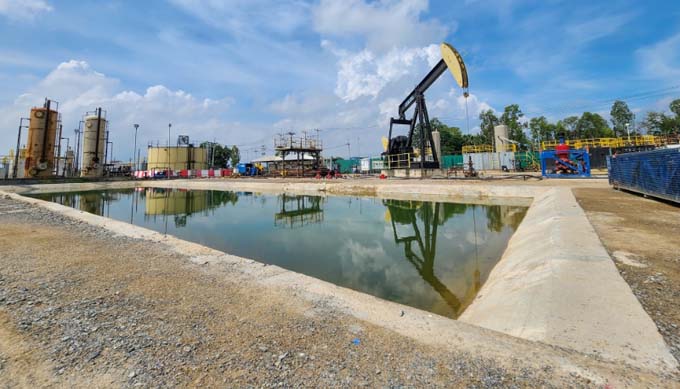
In line with DIALOG’s strategy to expand and diversify across its business streams, the Group completed the acquisition of Pan Orient Energy Corp. (POEC) in August 2022. POEC through its wholly owned subsidiary holds 50.01% equity interest in Pan Orient Energy (Siam) Ltd. (POES). The remaining 49.99% in POES is held by Sea Oil Energy Ltd.
POES is the concessionaire and operator of concession L53/48, located onshore in Nakhon Pathom and Suphanburi Province, about 100 km northwest of Bangkok, Thailand. It involved seven production areas. The acquisition is the first international DIALOG-operated upstream venture, paving the way for DIALOG to move further up the value chain in the upstream business.
The main activities in L53/48 concession focus on sub-surface evaluation to locate by-passed oil and untested reservoirs, appraisal and infill drilling as well as production enhancement activities to increase the recovery factor. In addition, it is also to evaluate low gravity oil resources for possible enhanced oil recovery to increase the reserve base. The oil from Concession L53/48 is sold to a local refinery.
Horizon Oil
Horizon Oil conducts oil and gas operations in Thailand through producing onshore natural gas assets in the northeast of the country. The company re-entered the Thai upstream sector in 2025 after acquiring interests from ExxonMobil through its subsidiary Horizon Thailand Investments. The acquisition gave Horizon stakes in two producing gas fields, the Sinphuhorm gas field and the Nam Phong gas field.
In the Sinphuhorm field Horizon holds a 7.5% working interest within the E5N and EU1 development licences, while the field is operated by PTT Exploration and Production (PTTEP). The field was discovered in 1983 and began production in 2006 from a fractured carbonate reservoir in the Permian Pha Nok Khao formation. It is developed with multiple wells tied to a central gas processing facility capable of handling roughly 140 million standard cubic feet per day of gas. The produced gas is transported to processing facilities and ultimately sold under long-term contracts to Thailand’s state energy company PTT Public Company Limited for use in electricity generation.
Horizon also owns a 60% working interest in the Nam Phong gas field under the E5 development licence, making it the majority stakeholder in that asset. The field was discovered in 1981 and started production in 1990. It is a mature onshore gas reservoir with nine drilled wells, seven of which remain producing. Gas from the field is processed at a nearby gas stabilisation unit before being transferred to PTT’s metering system and supplied to the Nam Phong power plant operated by Thailand’s electricity authority.
Idemitsu Kosan
Idemitsu Kosan conducts oil and gas activities primarily through offshore exploration and development interests in the northern part of the Gulf of Thailand. The company’s upstream activities in the country focus on petroleum exploration blocks and potential joint development areas rather than large-scale operated producing fields. These projects are part of Idemitsu’s broader strategy to secure upstream energy resources across Southeast Asia.
One of the company’s key interests in Thailand is in the offshore concession known as Offshore Thailand Blocks 5 & 6, located in the northern Gulf of Thailand near the maritime boundary between Thailand and Cambodia. Idemitsu holds a 50% participating interest in this block, while the remaining interests are held by Mitsui Oil Exploration and Chevron, with Chevron acting as operator. Exploration work in the block has historically included seismic surveys and exploratory drilling to evaluate hydrocarbon potential in the offshore basin.
The block lies in a geologically prospective region containing several petroleum systems associated with the Pattani and Khmer basins, which host numerous oil and gas discoveries elsewhere in the Gulf of Thailand. Although the block has undergone exploration campaigns since the 1970s, development has been constrained by the maritime boundary overlap between Thailand and Cambodia, and therefore the area is often considered for potential joint development between the two countries if commercial discoveries are confirmed.
Medco Energi
Medco Energi operates in Thailand through its subsidiary Medco Energi Thailand, where its activities are primarily focused on upstream oil and gas exploration, development, and production. The company’s presence in Thailand is part of its broader Southeast Asian portfolio and is centered on offshore assets in the Gulf of Thailand.
Medco’s Thai operations were significantly expanded following its acquisition of assets from ConocoPhillips in 2014. This deal included interests in several producing fields and established Medco as an operator in the country. Its key producing areas are located in offshore concessions such as Bualuang, which is one of the main oil fields under its operatorship. The Bualuang Oil Field produces crude oil from a series of wellhead platforms and is supported by floating storage and offloading infrastructure.
In addition to oil production, Medco’s portfolio in Thailand includes natural gas assets, notably its participation in the Sinphuhorm onshore gas field in northeastern Thailand. The Sinphuhorm Gas Field supplies gas primarily for domestic power generation, aligning with Thailand’s energy security needs. Production from this field is transported via pipeline to local power plants, making it an important contributor to the country’s electricity supply.
Mitsui Oil
Mitsui Oil Exploration has maintained a long-standing presence in Thailand’s upstream oil and gas sector through exploration, development, and production activities, primarily in the Gulf of Thailand. The company operates via its local affiliate MOECO Thailand and has built a portfolio of both operated and non-operated interests.
One of its most significant assets is its participation in the Bongkot Gas Field, one of Thailand’s largest natural gas fields. MOECO holds a minority stake in this field, which is operated by PTT Exploration and Production.
The company’s Thai operations are focused largely on natural gas rather than oil, reflecting Thailand’s energy mix and demand profile. Gas produced from its portfolio is sold into the domestic market under long-term contracts, ensuring stable revenue streams.
Mubadala Energy
Mubadala Energy has had a presence in Thailand’s upstream oil and gas sector primarily through non-operated interests in offshore natural gas assets in the Gulf of Thailand.
The company’s most notable involvement in Thailand has been its participation in the Bongkot Gas Field, one of the country’s largest producing gas fields. Bongkot is operated by PTT Exploration and Production, with Mubadala Energy holding a minority stake as a joint venture partner. Production from Bongkot is a key contributor to Thailand’s domestic natural gas supply, feeding into pipelines that support power generation and industrial demand across the country.
Within Thailand, Mubadala Energy’s role has generally been that of a financial and technical partner rather than an operator, contributing to reservoir management discussions, field development planning, and optimization initiatives alongside its partners.
PTTEP
PTTEP is Thailand’s national petroleum exploration and production company, and it plays a central role in the country’s energy security. Most of its domestic operations are concentrated offshore in the Gulf of Thailand. The company operates the G1/61 project, which covers the Erawan, Platong, Satun, and Funan gas fields, and the G2/61 project, which includes the Bongkot field. Together these two concessions supply roughly 1,500 million cubic feet per day of natural gas, providing around 60 percent of Thailand’s total gas needs.
PTTEP also has a strong presence in the Malaysia–Thailand Joint Development Area, where in 2025 it acquired a 50 percent interest in Block A-18, adding about 300 million cubic feet per day to Thailand’s supply and covering around six percent of national demand.
Beyond conventional oil and gas production, PTTEP is working on low-carbon initiatives, notably Thailand’s first carbon capture and storage project at the Arthit field, which is expected to begin operating by 2026. The company is also studying the potential for a larger CCS hub in the Northern Gulf with international partners, aiming to support industrial decarbonization.
Through these upstream operations and emerging energy transition projects, PTTEP remains the backbone of Thailand’s natural gas supply while moving toward sustainability.
Valeura Energy
Valeura Energy operations in Thailand are focused on offshore oil production in the Gulf of Thailand, where it has built a portfolio of producing assets through acquisitions and redevelopment of mature fields. Its Thailand operations are primarily centered on oil rather than gas and are characterized by shallow-water offshore production with established infrastructure.
The company significantly expanded its presence in Thailand following its acquisition of offshore assets from Mubadala Energy in 2023. This transaction gave Valeura operatorship and interests in several producing fields, including the Wassana Oil Field, which became one of its core production hubs. Wassana is a shallow-water oil field that produces through fixed platforms and subsea wells tied back to centralized processing facilities.
In addition to Wassana, Valeura’s Thai portfolio includes interests in other Gulf of Thailand producing assets such as the Nong Yao Oil Field and the Manora Oil Field, both of which contribute to its overall production base. These fields are mature to mid-life assets, and Valeura’s strategy has focused on applying redevelopment drilling, workovers, and enhanced recovery techniques to stabilize and optimize output.
Valeura also holds interests in the Joint Development Area (JDA) between Thailand and Malaysia, where gas and condensate production is managed under a cross-border framework involving Thai and Malaysian authorities. These assets provide additional production diversification, although the company’s primary focus in Thailand remains oil-led offshore production.
Renewable energy
Thailand’s renewable energy sector has grown steadily over the past two decades and is now an important component of the country’s electricity system, although it still operates alongside a dominant natural gas-based power fleet. The sector is guided by long-term national energy planning, primarily the Power Development Plan (PDP), which sets targets for renewable capacity expansion, system reliability, and emissions reduction. Policy support from the Ministry of Energy and procurement oversight by the Electricity Generating Authority of Thailand (EGAT) have been central in shaping investment and project development across solar, wind, biomass, and small hydropower.
Solar power is the largest and most dynamic renewable energy source in Thailand. The country’s strong solar irradiation, particularly in the central and northeastern regions, has enabled widespread deployment of utility-scale solar farms as well as distributed rooftop systems. Early growth was driven by incentive schemes such as feed-in tariffs and adder programs, which attracted significant private investment from both domestic conglomerates and foreign developers. More recently, Thailand has shifted toward competitive auctions and direct procurement frameworks, improving cost efficiency while continuing to expand capacity. Hybrid solar projects incorporating battery energy storage are also emerging, reflecting the need to manage intermittency and support grid stability as solar penetration increases.
Wind energy represents a smaller but strategically important segment of the renewable mix. Most wind farms are located in the northeastern and western regions, where wind conditions are most favorable. Although installed capacity is lower than solar, wind power provides a complementary generation profile, often producing more consistently during evening or seasonal periods when solar output declines. Development has largely been led by independent power producers and Thai energy companies operating under long-term power purchase agreements with state utilities.
Biomass and biogas play a distinctive role in Thailand due to the country’s strong agricultural and agro-industrial base. Biomass plants use residues such as rice husks, sugarcane bagasse, palm waste, and rubber wood, converting agricultural by-products into electricity. These facilities are typically located near farming or processing centers, supporting rural economies and reducing waste. Biogas systems, derived from wastewater and organic agricultural materials, are increasingly used in industrial facilities such as palm oil mills and food processing plants, contributing both to energy production and waste management solutions.
Small hydropower contributes a limited but stable share of renewable generation, mainly in northern Thailand where river systems and terrain support run-of-river projects. Larger hydropower resources are mostly located outside the country, particularly in Laos, where Thailand imports electricity under bilateral agreements. As a result, domestic hydro development remains relatively constrained, with most growth in renewables coming from solar and biomass rather than large-scale hydro expansion.
Thailand’s renewable energy market is structured around a combination of independent power producers, small power producers, and state-linked utilities. EGAT remains a central actor in purchasing and balancing electricity supply, while also investing in some renewable projects directly. Private sector participation is strong, with Thai conglomerates increasingly diversifying into clean energy alongside international developers from Japan, China, and Europe. This mix of domestic and foreign investment has helped accelerate project deployment and technology transfer, particularly in solar and wind development.
In recent years, grid integration and energy storage have become increasingly important as renewable penetration rises. Battery storage systems are being deployed to smooth solar variability and improve peak load management, while grid modernization efforts aim to enhance flexibility and reliability. These developments reflect Thailand’s gradual transition toward a more diversified power system, where renewables play a growing role but still operate in coordination with a gas-dominated baseload structure.
Renewable energy company operations in Thailand
Gulf Energy Development
Gulf Energy Development, which is one of Thailand’s largest power producers overall and has rapidly expanded into renewables alongside its traditional gas-fired generation portfolio. Gulf Energy invests in solar, wind, and cross-border renewable projects, often in partnership with state-linked entities and international developers.
Gulf Development Public Company Limited
87 M.Thai Tower 11th Floor
All Seasons Place, Wireless Road
Lumpini, Pathumwan Bangkok 10330
Thailand
(+66) 02 080 4499
contact@gulf.co.th
Electricity Generating Public Company (EGCO)
EGCO Group, the first Independent Power Producer in Thailand, is a holding company which has focused on power business investment both in Thailand and overseas and seen investment opportunities in other energy-related business. EGCO Group’s power plants generate electricity from a diverse range of fuels, including natural gas, LNG, coal, biomass, hydropower, solar power, onshore and offshore wind power, fuel cells, and battery energy storage, to help ensure energy security and support the energy transition toward a low-carbon society.
EGCO Group's investment is divided into three business segments, covering the entire supply chain. Upstream involves investment in fuel and infrastructure business. Midstream focuses on power business, which is EGCO Group's core business, with the majority of revenue and operating profit derived from this segment. The downstream business involves investment in customer solution and startup business.
The company operates across seven countries: Thailand, Lao PDR, the Philippines, Indonesia, South Korea, Taiwan, and the USA.
EGCO Group
EGCO Tower, 14th, 15th Floor
222, Vibhavadi Rangsit Rd.
Tungsonghong, Laksi
Bangkok 10210
Thailand
Tel: (66) 2998 5000
Ratch Group
Ratch Group Public Company Limited is a Thailand-based independent power producer headquartered in Bangkok. The company was established in 2000 following a restructuring of Thailand’s electricity sector and is closely associated with the Electricity Generating Authority of Thailand, which remains a major shareholder. Ratch Group focuses on investing in and operating power generation assets, along with related infrastructure and energy services, both domestically and internationally.
Its core business involves the development, ownership, and operation of power plants across a diversified portfolio that includes natural gas, coal, renewable energy such as solar, wind, and hydroelectric projects, as well as emerging energy technologies. Over time, the company has expanded beyond Thailand into several countries across Asia, Australia, and other regions, reflecting a strategy of geographic diversification and long-term investment in energy infrastructure.
Ratch Group Public Company Limited
72 Ngamwongwan Rd
Bang Khen Subdistrict
Mueang Nonthaburi District
Nonthaburi Province 11000
Thailand
(66) 0 2794 9999
contactinfo@ratch.co.th
BCPG
BCPG Public Company Limited is a Thailand-based renewable energy company focused on the development, investment, and operation of clean power projects across Asia and other international markets. It was established as a subsidiary of Bangchak Corporation Public Company Limited as part of the group’s strategy to expand into sustainable energy and reduce reliance on fossil fuels.
The company’s core business centers on renewable power generation, particularly solar energy, where it operates a portfolio of utility-scale and rooftop solar projects in Thailand, Japan, and other countries. Over time, BCPG has diversified into additional renewable technologies, including wind power, hydropower, and geothermal energy, reflecting a broader commitment to building a balanced clean energy portfolio.
BCPG also invests in energy innovation and smart energy solutions, such as energy storage systems, microgrids, and digital energy platforms. These initiatives support the integration of renewable energy into power systems and enhance efficiency and reliability for customers and grid operators. Its revenue is primarily derived from electricity sales under long-term power purchase agreements, as well as from merchant market participation in certain regions.
BCPG Public Company Limited
2098 Sukhumvit Road
Phra Khanong Tai
M Tower Building, 12th Floor
Phra Khanong, Bangkok 10260,
Thailand
+66 2335 8999
Energy Absolute
Energy Absolute Public Company Limited is a Thailand-based renewable energy and technology company focused on the development of integrated clean energy solutions. Founded in 2006 and headquartered in Bangkok, the company has evolved from its origins in biodiesel production into one of the country’s leading players in renewable power, electric mobility, and energy storage.
Its core business includes the generation of electricity from renewable sources such as solar and wind, alongside the production of biofuels including biodiesel and advanced bio-based products. Over time, Energy Absolute has expanded into adjacent sectors, building a vertically integrated ecosystem that spans lithium-ion battery manufacturing, electric vehicle production, and charging infrastructure, supporting the broader transition to low-carbon energy systems.
The company positions itself as a developer of end-to-end energy solutions, combining power generation with downstream technologies such as electric ferries, commercial EVs, and battery systems. This integrated approach is aimed at enhancing energy security, reducing emissions, and supporting Thailand’s shift toward sustainable transportation and energy use.
Energy Absolute Public Company Limited
16th Floor, AIA Capital Center Building
89 Ratchadaphisek Road
Dindaeng, Bangkok 10400
Thailand
+66 (0) 2248 2488 92
Gunkul Engineering
Gunkul Engineering Public Company Limited is a Thailand-based energy and infrastructure company engaged in renewable power generation, electrical equipment manufacturing, and engineering services. Founded in 1982 and headquartered in Bangkok, the company has developed into a fully integrated energy business operating across multiple segments of the power value chain.
Its core activities include the generation and sale of electricity from renewable sources such as solar and wind, alongside investments in power projects both domestically and internationally. In addition to power generation, Gunkul Engineering manufactures and distributes electrical equipment and components used in transmission and distribution systems, and provides engineering, procurement, and construction services for energy and infrastructure projects.
The company also offers operation and maintenance services for power plants and develops energy-related solutions, including energy-saving products and emerging technologies such as battery storage and digital energy platforms. Its diversified business model allows it to participate across the lifecycle of energy projects, from equipment supply and construction to long-term operation and asset ownership.
Gunkul Engineering Public Company Limited
548 One City Centre (OCC), 44th Floor
Phloen Chit Road, Lumphini
Pathum Wan, Bangkok 10330
Thailand
02 242 5800
Sermsang Power Corporation
Sermsang Power Corporation is a Thailand-based renewable energy producer focused on investing in and operating clean power projects across Asia, with a particular emphasis on solar energy. The company was originally established as part of a business group with roots in energy trading and has since transformed into a dedicated power generation platform specializing in renewable infrastructure.
Its core operations involve the development, ownership, and operation of solar power plants, primarily in Thailand and Japan, with additional expansion into other Asian markets. The company typically generates revenue through long-term power purchase agreements with utilities and industrial off-takers, which provide stable and predictable cash flows. Over time, Sermsang Power has also explored diversification into other renewable technologies and adjacent energy businesses to support growth and portfolio resilience.
Through its focus on solar energy and regional expansion strategy, Sermsang Power Corporation positions itself as a niche renewable energy investor aiming to deliver sustainable electricity generation while participating in the broader transition toward low-carbon energy systems in Asia.
Sermsang Power Corporation PLC
325/14 Lanlaung Rd
Mahanak Square
Dusit, Bangkok 10300
Thailand
info@sermsang.co.th
+66 2 628 0991 2