 KEYFACT Energy
By Catherine McBride OBE
Scraping the carbon tax is a great idea - but the UK has more than one of them
While I was delighted to see X posts from the Conservative Party claiming they would scrap ‘the’ Carbon Tax, I hate to break it to them, but there is more than one. Just as with the mythical ‘global oil price’ and the mythical ‘international gas price’, there is no single UK Carbon Tax; there is not even a single carbon tax on electricity production. The UK has 3 carbon taxes on electricity and at least 19 different taxes, charges, levies, and duties on energy, as well as financial regulations that have increased the cost of all types of energy.
Scrap the carbon tax – but which one?
The three UK carbon taxes on electricity, any one of which could possibly represent ‘The Carbon Tax’ on electricity in the eyes of the Conservative Party, are:
-
The Emissions Trading Scheme (ETS) requires certain companies to buy allowances to cover their CO2 emissions. Not all industries and activities are covered by the ETS scheme; however, electricity production from coal, gas, oil and biomass plants definitely is. The ETS also applies to emissions from energy use and from industrial processes, such as the production of steel, cement, ceramics, chemicals, pulp and paper, and aluminium, whereas emissions from administrative, office, and general business operations are exempt.
The ETS was introduced by the EU in 2005. The UK should have scrapped it the moment we left the EU. It does nothing but ensure that the UK’s industrial base is replaced by imports from countries without an ETS, such as Japan, Turkey, India, Vietnam, Bangladesh, etc. (I really could go on and on here). However, the EU built the retention of the ETS into the UK-EU Trade and Cooperation Agreement (CTA). So scrapping this Carbon Tax might be trickier than the Conservatives imagine. Abandoning the Emissions Trading Scheme would allow the EU to break the CTA if this made UK goods more competitive in the EU market. However, as the UK currently has a massive goods trade deficit with the EU, UK goods would have to become considerably more competitive before the EU would have a valid case for breaking the trade agreement. To scrap this tax, the Conservatives would just need the political will to stand firm and call the EU’s bluff.
Unfortunately, by the time of the next election, scrapping the ETS may be even more difficult, as the current Labour government plans to join the EU’s even more expensive ETS scheme. Nonetheless, if the Conservatives want to make a substantial difference to the UK’s economic fortunes, this is the carbon tax to scrap. It will not only reduce industrial electricity costs but also help other industries currently required to buy ETS allowances for their manufacturing emissions.
-
An easier ‘Carbon Tax’ to scrap is the Carbon Price Support (CPS) tax. The Cameron/Clegg coalition introduced the CPS in 2013 supposedly to discourage the production of coal-fired electricity. It is part of the UK’s Climate Change Levy framework and applies only to industrial and commercial electricity users. The last coal-fired power plant closed in September 2024, but this additional tax of £18 per tonne of CO2 is still being added to industrial and commercial electricity bills.
This tax was instrumental in the UK’s deindustrialisation, as it made UK industrial electricity more expensive than in other EU countries which did not impose a similar tax, even though many EU countries relied on coal-fired electricity production. (Nine EU members still rely on coal-fired electricity.) The CPS even made UK gas-fired electricity uncompetitive compare to other EU gas-fired electricity. According to Electric Insights in the first half of 2021, a British gas-fired power station paid £65 per tonne of CO2 emitted, but one in Belgium or the Netherlands paid only €44 (£38). The Chemical Industry Association estimates that the CPS adds about £8 per MWh to electricity costs. The Centre for British Progress claims the CPS increased electricity costs by more than £3.50 for every £1 it generates for the Exchequer in 2024. Everyone who pays it, hates this tax. Politically, it would be the easiest one to scrap.
-
The third choice for ‘the Carbon Tax’ to scrap is the Climate Change Levy (CCL), a tax on business, agricultural, and public-sector energy use, but not on domestic energy use. The CCL varies by energy type and is charged on electricity, gas, LPG and solid fuels. The rates were increased on April 1st and are now £0.00801 per kWh for electricity, £0.00801 per kWh for gas, £0.02175 per kWh for LPG, and £0.06264 per kg for other taxable commodities. The rate will increase again on April 1st next year. While these rates may seem small to a domestic user, many businesses that pay this levy use large amounts of electricity.
There are substantial discounts for Energy Intensive Industries if they are in an eligible product sector, their electricity costs exceed 5% of their Gross Value Added, and they meet the requirements of the Climate Change Agreement. What are these requirements? Commit to the energy efficiency and/or carbon efficiency targets for their industry and demonstrate that they have met the targets over a two-year period, or pay a buy-out fee. The fee was £18 per tonne of CO2e in 2023 and 2024, and calculated on the shortfall between the target and actual emissions, then paid to the Environment Agency. There were several problems with this system, not least that the buy-out price of £18 per tonne of CO2e was considerably lower than the UK ETS carbon prices, encouraging companies to sign up for the scheme but fail to reduce emissions. But there were also problems with verification standards and inconsistent reporting.
While the CCL is still enforced and the discounts still exist, the buy-out system has now been replaced by a new six-year scheme that started on January 1 2026, and will run until 2033. It has brought more sectors into scope, set tighter targets, and expanded carbon metrics beyond energy efficiency. The monitoring and verification rules have been strengthened, giving the Environment Agency the power to audit reported reductions and ensure they are real.
However, the process of measuring emissions and complying with the CCA requirements is an additional cost for UK businesses, on top of the taxes added to their electricity, gas, LPG, and solid fuel bills. The added complication of charging a levy, then allowing massive discounts of 92% off the electricity CCL, 88% off the gas CCL, 77% of the LPG CCL, and 86% off the solid fuel CCL, provided companies comply with auditable emission reduction targets, adds another layer of bureaucracy. While the Environment Agency’s monitoring and auditing of company emissions is another cost to taxpayers.
An even more destructive tax, but not a carbon tax
But aside from the confusion about exactly which carbon tax the Conservatives are proposing to scrap, they have also vowed to increase oil and gas licences, claiming this would boost production, raise tax revenues, and bring down bills. However, more licences will not encourage companies to increase oil and gas production in the UK while the current tax regime is in place.
Besides new licences, the Conservatives would need to scrap the Windfall Tax, which they introduced in 2022 at 25% and raised in 2023 to 35%. The Labour government made it worse by increasing it to 38% and reducing the allowances for exploration and development expenses. The Windfall Tax is in addition to the 40% ring-fenced corporate taxes that oil and gas companies already pay on their North Sea production. The Windfall Tax raised the total tax rate on oil and gas companies from 40% to 65%, then to 75%, and now to 78%. Unsurprisingly, production fell as the tax rate increased.
The Windfall tax was designed as a revenue-raising tax rather than an environmental one, such as the three ‘Carbon Taxes’ discussed above. But it has reduced UK carbon emissions by curtailing oil and gas production. In 2021, the UK produced 38.241 million tonnes of crude oil. In 2022, despite the price spike following Russia’s invasion of Ukraine, UK production dropped to 35.348 million tonnes, most likely due to the introduction of the 25% windfall tax. In 2023, when the windfall tax was increased to 35%, production fell again to 31.102 million tonnes. In 2024, when the tax was increased to 38%, production fell to 28.019 million tonnes. But the UK’s demand for crude oil didn’t change in line with the tax increase; instead, crude oil imports (from countries without a Windfall Tax) increased from 35.58 million tonnes in 2020 to 43.39 million tonnes in 2024. Increasing the UK’s trade deficit.
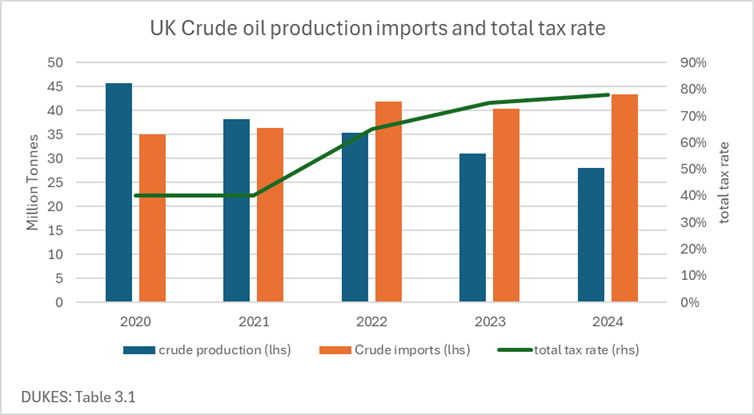
In addition to the reduction in production, the total tax revenue from oil and gas companies has also fallen from £9.3 billion in 2022/23 to just £2.7 billion in 2025/26. The government had previously claimed to have raised £9.9 billion in 2022/23 from oil and gas taxes, but this figure has been revised down to £9.3 billion, making this ridiculous tax even more ridiculous. It never raised the massive revenues expected when it was introduced; in the OBR’s November 2022 EFO they predicted tax revenues of £14.9 billion in 2022/23 and £20.7 billion in 2023/24. Instead, the Windfall tax just reduced UK crude oil production, increased crude imports and increased the UK’s trade deficit. It also caused at least one company, Harbour Energy, to cut about 700 employees. Other North Sea operators have announced reduced investment, cancelled drilling, and/or paused their projects.
Without restricting new licences, the Windfall Tax has been instrumental in lowering oil and gas production in the North Sea, and has encouraged some companies to refocus their production in other parts of the world, or even simply other parts of the North Sea, such as the Norwegian part.
So, while I fully support the Conservatives’ announcement that they will end Labour’s ban on new drilling, they will also have to remove the Windfall Tax and reinstate the tax allowances if they are to increase oil and gas production in the North Sea.
Temporary taxes made permanent
While they are at it, the Conservatives should also pledge to scrap the Oil and Gas Price Mechanism (OGPM) that is due to replace the Windfall Tax in 2030. The OGPM will be a permanent tax of 35%, applied to UK oil and gas firms operating in the UK and the UK Continental Shelf, and will be charged on the realised price a company receives above a threshold price of £90 per barrel for oil and 90p per therm for gas. This tax will also be in addition to the ring-fenced 30% Corporate Tax and 10% Supplementary Charge paid by UK oil and gas companies. The threshold prices are not indexed and will be set manually by the government each year. The OGPM will become active if the EPL ends earlier than 2030 due to two consecutive quarters of low oil and gas prices.
Charging an additional 35% tax on a commodity when the price is high totally misunderstands how the price mechanism works. Commodity prices move with supply and demand. When prices are high, supply increases, lowering prices. If the government increases the tax rate when prices increase, there will be less incentive for companies to increase supply, or at least less incentive for them to increase supply in the UK, and we will be back to the situation we find ourselves in now: high oil and gas commodity prices but low UK oil and gas production, investment and employment. And almost no oil and gas tax revenue.
More information
If you want to know more about the many taxes, levies, charges and other restrictions that the UK applies to its oil and gas, electricity, and other manufacturing industries, and how this has harmed the UK economy read the Great British Business Council’s new paper, entitled “Premeditated Industrial Destruction: How the UK destroyed its industries and a plan to reverse this.”
Original article l KeyFacts Energy: Commentary