 KEYFACT Energy
Anthony Minghella's 1996 movie, The English Patient, is a love story set in the middle of the Saharan Desert. A large part of the movie (and the book) is fictional. Arguably the real star of the movie is not Ralph Fiennes or Kirstin Scott Thomas but the Cave of Swimmers.
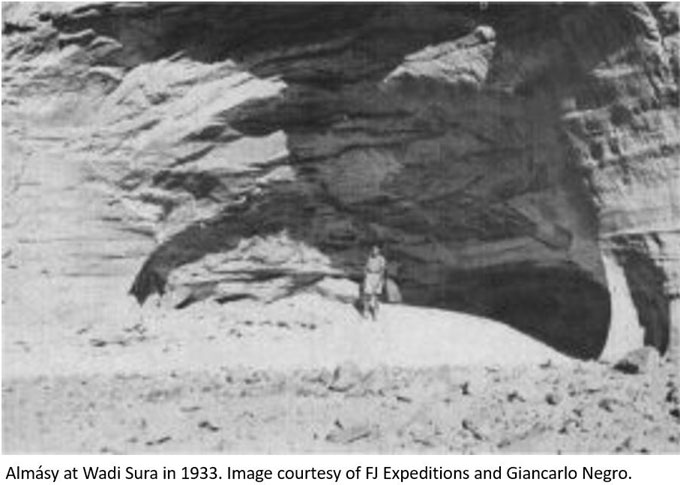
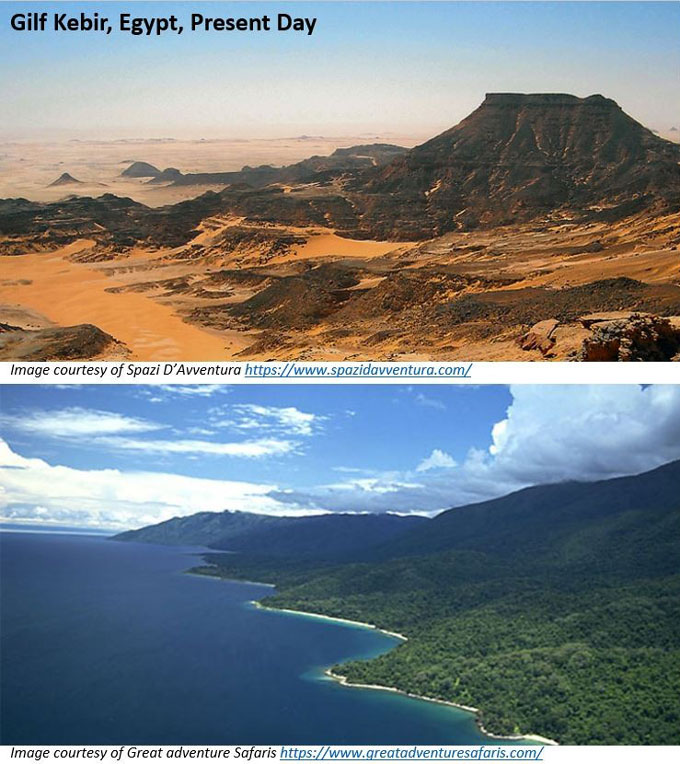
The patient is not English but Hungarian; Count László de Almásy. The cave really isn't a cave more a couple of hollows at the base of a cliff. Almásy was part of a 1933 Royal Geographical Society expedition to Wadi Sura on the Gilf Kebir plateau in southwest Egypt close to the Libyan and Sudanese borders. In a key part of the movie Almásy (played by Ralph Fiennes) shines a light that illuminates the far side of the cave. He reveals ancient rock art with giraffe, hippopotamus and humans with arms and legs outstretched, who appear to be swimming. Other rock art in the area depicts abundant elephants, giraffe, hippos, aurochs (a wild ancestor of domestic cattle) and antelope, all occasionally being pursued by bands of hunters. There appears to be an abundance of food and water at this time, our ancestors lived in a rich and fertile land.
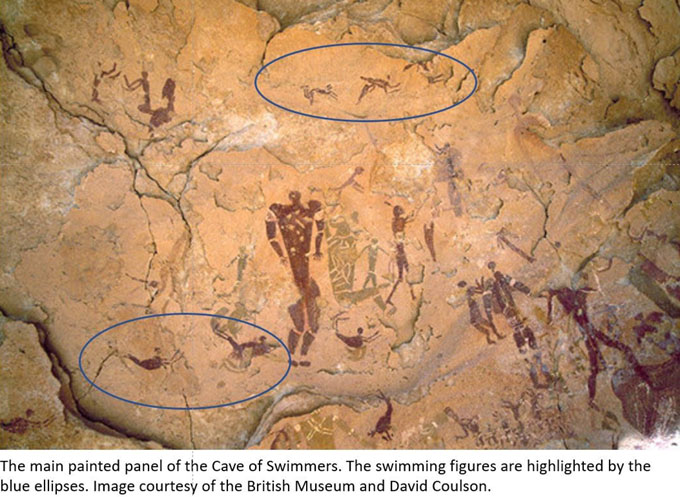
The Bradshaw Foundation provides a online learning resource that promotes the study of early humankind's artistic achievements. They have created a 3D visualisation of the rock art at Gilf Kebir and the Cave of Swimmers - click on the link to explore the beautiful high resolution images.
A growing body of academic research suggests the onset of the current dry Sahara, 5500 years ago, forced the swimmers of Gilf Kebir to leave their once rich and fertile land. They migrated east to the Nile and took their skills, knowledge and culture with them. Their ancestors would go on to develop one of the most sophisticated civilizations the world has ever seen.
Almásy wasn't the first 'outsider' to discover rock paintings depicting a 'Green Sahara'. The local Bedouin knew of the the rock paintings and acted as guides for the 1933 and other expeditions. They likely brought the expedition to the rock art at Wadi Sura, this aspect appears to have been 'forgotten'. In 440 BC Greek historian Herodotus (whose writings often feature in the movie) discussed the existence of a 'Green Sahara'. In the mid 1800s German explorer Heinrich Barth became the first European to discover the mysterious prehistoric Saharan rock paintings and engravings. The most recent wetter period between 14,500 and 5,500 years ago is termed termed the African Humid Period.
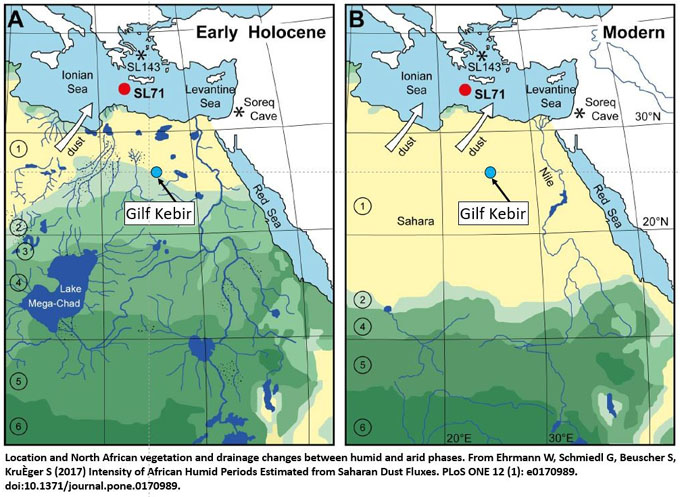
Peter B. de Menocal & Jessica E. Tierney in their 2012 article in Nature Education highlight how 'Most of the early Holocene paleolakes were small, but numerous and widespread. Some lake basins in North Africa were exceptionally large, as large as the Caspian Sea today. Based on their stratigraphic records, these must have been permanent, open-basin lakes, indicating that annual moisture supply exceeded evaporation for many millennia during the African Humid Period, even in the driest regions of the modern-day Sahara.' Ehrmann et al in their 2017 paper illustrate the location of vegetation an drainage of the humid and arid phases as shown in the maps below.
The water in the lakes that once covered the Saharan desert has long since evaporated but some of the ancient lake waters became trapped underground. In 1953, efforts to find oil in southern Libya led to the discovery of large quantities of water in the the Nubian Sandstone Aquifer System - the world's largest known fossil water aquifer system. Mostafa Sadek and colleagues from the Egyptian Atomic Energy Authority detail the isotopic and age characteristics of the groundwater in the Nubian sandstone aquifer in a 2001 paper. Radio-carbon dating of the Nubian sandstone aquifer water samples in the East El-Uweinat and Tushka is from 14,780 to 17,070 years BP. The citizens of Tripoli and Benghazi in Libya are today drinking water from the last Saharan humid period thanks to a $30 billion underground network of pipelines known as the Great Man Made River. It pumps freshwater in the Nubian sandstone aquifers in the south, to the cities on the Mediterranean. The fascinating 2001 documentary by Winfried Spinler and his crew entitled 'Pipeline to Paradise (Gaddafi's Gift to Libya)', is really worth a watch.
What was the cause of such a rapid change in ecosystems 5500 years ago?
At the same time that Almásy was exploring the desert, a Serbian a mathematician and astronomer was developing a radical theory that would explain the changes that allowed our ancestors to swim in that expansive lake in and around Wadi Sura more than 5500 years ago. A theory that is still evolving and only became widely accepted by the scientific community after his death in 1958. Milutin Milanković identified three ways the Earth's orbit around the Sun changes over the course of tens to hundreds of thousands of years. Each of the three, eccentricity, axial tilt and precession all influence how much solar energy hits the Earth.
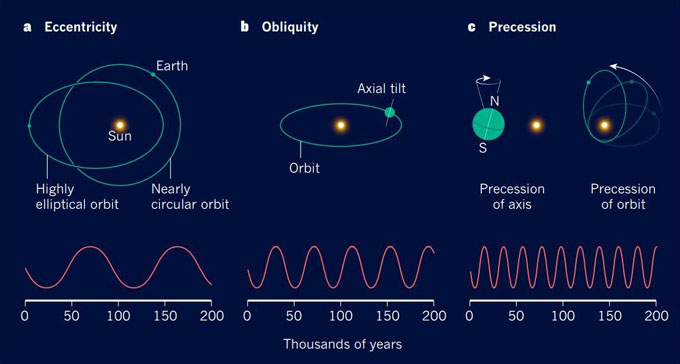
Milanković theorised that the change in solar energy would be a major factor controlling climate - a process called orbital forcing. In 1976, Hays, Imbrie and Shackleton published one of the most influential papers in the study of Earth’s past climate. Mark Maslin from Department of Geography in UCL in his 2016 article in Nature says 'they legitimized what was to become one of the most powerful tools in stratigraphy'. Obliquity has a strong influence at high latitudes, whereas precession has a significant impact on seasonality in the tropics. The cycle of axial precession spans 25,771.5 years and has been linked to the waning and waxing of East and North African lakes, including the one that existed at Wadi Sura more than 5500 years ago.
These orbital cycles would become known as Milanković Cycles. Milanković Cycles would not exist without the axial tilt of the Earth and without Venus, Jupiter and Mars being just the right size and just the right distance from the Earth. They would not exist without the Moon being just the right size and just the right distance from the Earth. And off course the Earth is in a goldilocks zone that is just the right distance from the Sun. The Sun has a well established 11 year sun spot cycle and a number of longer period cycles that are just beginning to be revealed. The list of things that are just right or were just right at Earth goes on and on.
We only need to look at our nearest neighbours to see what can happen when things are not just right. Venus has no virtually no axial tilt and hence no seasons. A Venusian day is 243 Earth days and Venus is a long way from the goldilocks zone. Mars has a similar axial tilt to Earth and has seasons, but it's moons are and were too small to have resulted in tides in the billion year old lakes that once covered it's surface.
The importance of the 5000 - 15,000 year switch from hot to cold, from wet to dry, that has been occurring again and again during the current 3 million year long ice age is only beginning to be fully appreciated and understood.
Wadi Sura and the Cave of Swimmers provide a window into how we came to be. Milanković Cycles are the engine of evolution and without them we wouldn't exist.
Ciaran Nolan, Senior Consultant Geoscientist, Nolan Geoscience Limited
KeyFacts Energy Industry Directory: Nolan Geoscience