 KEYFACT Energy
Türkiye's state energy company, Turkish Petroleum Corporation (TPAO) has signed a MOU with ExxonMobil, covering exploration parts of the Black Sea and the Mediterranean. TPAO General Manager Cem Erdem and ExxonMobil Vice President John Ardill signed the agreement at a ceremony held in Istanbul on January 8th, 2026.
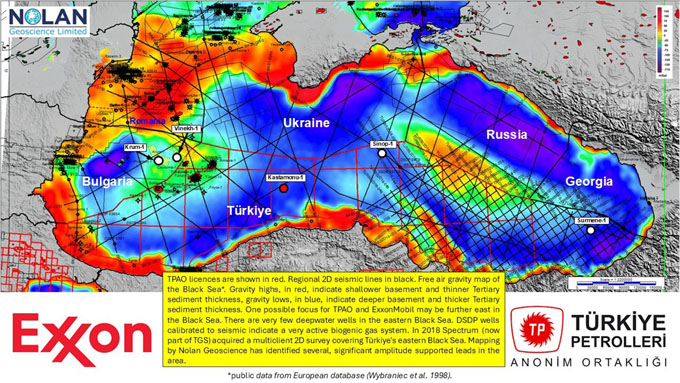
ExxonMobil and TPAO have had several MOU’s and partnerships in the past. In 2008, during the initial phase of deepwater exploration in the Black Sea, TPAO and ExxonMobil evaluated the Samsun licence resulting in two deepwater wells, Kastamonu-1 and Surmene-1. Kastamonu-1 encountered gas in shallow Pliocene sands, which at the time, were considered non-commercial.
After the early failures in Türkiye, ExxonMobil’s Black Sea exploration focus shifted to Romania, and the deepwater extension of the Plio-Miocene biogenic gas play, previously established by shallow water discoveries Ana and Doina. 3D seismic mapping identified a series of structures, many had seismic attributes, potentially indicative of gas bearing sands. Between 2011 and 2015 ExxonMobil operated eight deepwater wells offshore Romania. In 2012 ExxonMobil and partner OMV Petrom completed Domino-1, which encountered 71m of net gas pay. Subsequent exploration and appraisal drilling was a mixed bag of success and failure. One highlight was the Pelican South discovery in 2015. Domino and Pelican South are now part of the Neptun Deep gas project.
In Q4 2019 the Western Black Sea exploration focus shifted back to Türkiye, Shearwater GeoServices acquired a 6200km sq 3D on behalf of TPAO. TPAO geoscientists identified a series of structures on the 3D. Again, the Plio-Miocene intervals within the structures had a series of seismic attributes that were potentially indicative of gas bearing sands. In July 2020 TPAO drilled Tuna-1, the Sakarya discovery well which encountered gas in three main reservoirs. According to TPAO, total discovered resources in the greater Sakarya area are estimated to be 785 BCM (25 TCF).
Western Black Sea exploration has now shifted to stratigraphic traps. OMV Petrom are using the drillship Globetrotter-1 to test the Vinekh prospect, upon completion the rig will move west, to test the Krum prospect. These are stratigraphic traps within the Plio-Miocene play. Once the Neptun Deep development drilling is completed, OMV Petrom will mobilise the Transocean Barents semi to test the Anaconda prospect, within the Neptun Deep extension license.
One possible focus for TPAO and ExxonMobil may be further east in the Black Sea. There are very few deepwater wells in the eastern Black Sea. DSDP wells calibrated to seismic data indicate a very active biogenic gas system. In 2018, Spectrum (now part of TGS) acquired a multiclient 2D survey covering Türkiye's eastern Black Sea. Mapping by Nolan Geoscience Limited has identified several significant amplitude-supported leads in the area.

Ciaran Nolan
Director, Nolan Geoscience Limited
KeyFacts Energy Industry Directory: Nolan Geoscience
